
You are exhausted all day, but the moment it is time to slow down, your body does the opposite. Your mind turns on. Your chest feels tense. You get a second wind at night, scroll longer than planned, sleep shallowly, and wake up feeling like you never recovered.
That “wired but tired” pattern is frustrating because it feels contradictory: low energy and high alertness at the same time.
The better frame is not laziness, weak discipline, or a mysterious crash in willpower. For many people, wired but tired is a stress-response timing problem: your body is producing alertness signals when you want recovery, then failing to produce steady energy when you need it.
This article explains what wired but tired means, why stress can create fatigue and alertness together, and the first three stabilizers to test before adding supplements or complicated recovery tools.
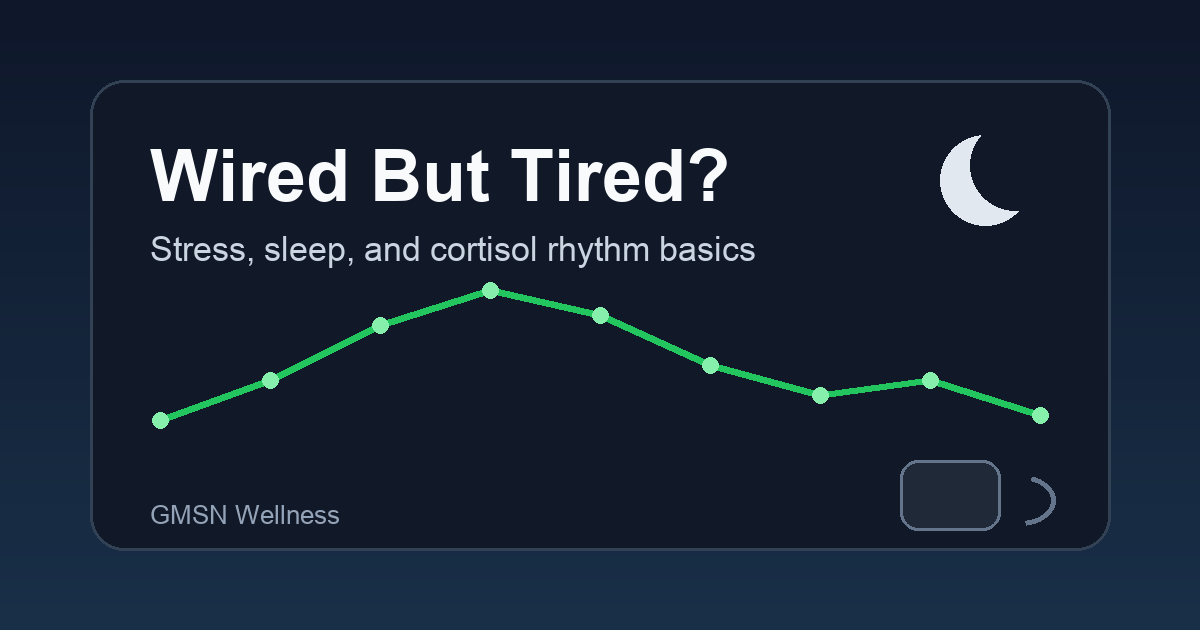
What this article covers
- What wired but tired means
- Why stress can create fatigue and alertness at the same time
- How cortisol timing affects sleep and morning energy
- Three stabilizers to test this week
- When to use the free Cortisol Reset Protocol
What wired but tired means
“Wired but tired” describes the combination of physical fatigue and nervous-system activation.
Common versions include:
- Feeling drained during the day but alert at bedtime
- Getting an evening “second wind” after dragging through the afternoon
- Lying down tired, then suddenly thinking through every problem in your life
- Falling asleep but waking between 2:00 and 4:00 AM
- Depending on caffeine to feel normal, then struggling to wind down later
- Waking unrefreshed even after a full night in bed
This is not a diagnosis. It is a symptom pattern. It can come from multiple causes: sleep debt, chronic stress, late caffeine, blood sugar swings, anxiety, overtraining, irregular light exposure, alcohol, medication effects, or an underlying medical issue.
The useful starting question is simple:
Is your energy showing up at the wrong time?
If your body feels activated at night and flat in the morning, the first move is to stabilize the signals that control timing: light, caffeine, food, movement, and evening stimulation. For more background, read GMSN Wellness on the effects of stress on the body.
Why stress can create fatigue and alertness at the same time
The body uses stress hormones and nervous-system activation to help you respond to demand. That response is useful in short bursts. The problem starts when your system keeps receiving signals that the day is not over: work messages at night, late caffeine, intense training, bright screens, alcohol-disrupted sleep, financial pressure, unresolved conflict, or constant mental load.
Over time, this can create two problems at once.
First, you may feel under-recovered. Sleep may be long enough in hours but not restorative in quality. If sleep quality is the main issue, see GMSN Wellness on the benefits of quality sleep and healthy sleep habits. You wake up with brain fog, low motivation, and a need for stimulation.
Second, you may still feel activated. Your body may be tired, but your stress response has not fully downshifted. That can feel like restlessness, rumination, shallow breathing, tension, or a sudden burst of energy late in the day.
This is why “just relax” rarely works. Relaxation is not only a decision. It is a physiological state supported by timing, environment, and repeated cues.
Cortisol at night: the timing issue
Cortisol is often discussed as if it is simply “bad,” but that is too simplistic. Cortisol helps regulate alertness, energy availability, inflammation, blood pressure, and the sleep-wake rhythm. For source material on cortisol physiology, see the Endocrine Society overview of cortisol and the MedlinePlus reference on cortisol testing. The goal is not zero cortisol. The goal is an appropriate rhythm.
A healthy daily rhythm generally trends higher in the morning and lower at night. Morning alertness helps you start the day. Evening decline helps the body transition toward sleep. For a broader sleep-health reference, see the National Heart, Lung, and Blood Institute overview of sleep deprivation and deficiency.
When people search for “cortisol at night,” they are often describing the felt experience of that rhythm being off: tired all day, then alert when they should be winding down. You do not need to prove this with a lab test before improving the basics. Start by removing the most common timing disruptors.
Wired but tired symptoms to watch for
1. Evening second wind
You may feel flat after lunch, push through the afternoon, then suddenly feel more alert around 8:00 or 9:00 PM. That second wind can be driven by delayed work stimulation, late caffeine, bright light exposure, stress rumination, or simply staying active long after your body needed a downshift.
2. Shallow or fragmented sleep
You might technically sleep, but wake easily, dream intensely, or feel as if you never dropped into deep recovery. Some people fall asleep quickly and wake in the early morning hours with an active mind.
3. Caffeine dependence
Needing caffeine is not a character flaw. But if you need multiple servings to reach baseline, caffeine may be covering a recovery problem instead of solving it. The later caffeine lands in the day, the more likely it is to interfere with the sleep you need to recover.
4. Brain fog and stress fatigue
Stress fatigue often feels like reduced bandwidth: slower word recall, less patience, scattered attention, and difficulty making decisions. For related context, see GMSN Wellness on stress and mental health. You are not necessarily incapable. Your system may simply be spending too much energy staying activated.
First: rule out red flags
Plain-language self-assessment is useful, but it does not replace medical care. For general sleep-health context, review the CDC overview of sleep and sleep disorders. Consider speaking with a qualified clinician if fatigue is severe, new, worsening, or paired with symptoms such as chest pain, fainting, shortness of breath, unexplained weight loss, fever, severe depression, panic symptoms, or major changes in appetite, thirst, urination, or menstrual cycle.
If your pattern is mild to moderate and clearly tied to schedule, stress, caffeine, screens, or recovery habits, the first experiment is to reduce the inputs that keep your system activated at the wrong time.
How to fix wired but tired: 3 stabilizers to test this week
1. Anchor the morning with light and movement
Your evening starts in the morning. Morning light helps set the daily rhythm that tells your body when to be alert and when to wind down later. For background on circadian rhythm biology, see the National Institute of General Medical Sciences overview of circadian rhythms.
For the next seven days:
- Get outside within 30–60 minutes of waking when possible. If walking is the easiest entry point, use GMSN Wellness on walking for exercise
- Walk for 5–10 minutes, even if the pace is easy
- Avoid starting the day in a dark room with only a phone screen
- Keep wake time as consistent as your schedule allows
The goal is not a perfect routine. The goal is a strong morning signal.
2. Put caffeine on a clock
Caffeine can be useful, but it is also a timing tool. For general consumer guidance on caffeine, MedlinePlus provides a plain-language reference on caffeine and health. If it lands too late, it may keep the stress-response loop active into the evening.
For the next seven days:
- Delay first caffeine until after water, food, or light exposure when possible
- Stop caffeine 8–10 hours before bedtime
- Track whether afternoon caffeine improves your day or creates a night problem
- If you use multiple servings, reduce the latest serving first
Do not treat caffeine as the enemy. Treat it as a lever. The question is whether it supports the rhythm you want or masks the recovery debt you need to address.
3. Build a real evening downshift
If your day ends at full speed, your body may not receive a clear transition signal. A downshift does not need to be complicated. It needs to be repeatable. If you need a non-screen option, GMSN Wellness has related guidance on meditation for stress and sleep meditation apps.
For the next seven days, pick a 20-minute downshift window:
- Dim bright lights
- Stop work inputs and problem-solving tasks
- Put the phone away or use grayscale/night mode
- Take a warm shower, stretch lightly, or read something non-stimulating
- Write tomorrow’s first task on paper so your brain stops rehearsing it
The key is consistency. Your nervous system learns from repeated cues.
What not to do first when you feel wired but tired
When people feel wired but tired, they often jump straight to supplements, extreme restriction, or complicated morning routines. Those may help some people, but they are not the first move.
Avoid starting with:
- A large supplement stack before fixing sleep timing
- Late-night intense workouts if they clearly increase alertness
- More caffeine to override morning fatigue
- Doom-scrolling under the label of “relaxing”
- Treating every bad night as a crisis
The first objective is to remove the obvious friction points before adding new tools.
Optional support: Gray Matter for stress-related focus
If your wired-but-tired pattern comes with brain fog, scattered attention, or a heavy dependence on caffeine, the first move is still the basics: morning light, caffeine timing, food, movement, and an evening downshift.
Once those foundations are in place, some readers may want additional support for focus and stress resilience. Gray Matter Labs is one option worth reviewing because its stack is built around cognitive performance, smoother energy, and adaptogen-based stress support rather than another high-stimulation caffeine hit.
The most relevant fit for this article is the stress-and-focus angle: readers who feel mentally foggy during the day but overstimulated at night should avoid chasing more intensity and look for tools that support calm, steady output.
Review Gray Matter options here:
https://trygraymatter.com/GUSTAVOMARTINEZ
*Affiliate disclosure: GMSN Wellness may earn a commission if you purchase through this link, at no extra cost to you. This is not medical advice, and supplements should not replace sleep, nutrition, stress management, or care from a qualified clinician.*
Wired but tired self-assessment checklist
If the pattern keeps repeating, use a structured checklist instead of guessing.
Ask:
- Is caffeine landing too late?
- Is morning light inconsistent?
- Is the evening full of work inputs, screens, or conflict?
- Is sleep opportunity long enough but low quality?
- Is the afternoon crash driving more stimulation?
- Is stress showing up as brain fog, irritability, or decision fatigue?
A checklist turns vague fatigue into an action plan.
Free guide: Cortisol Reset Protocol
If you want a structured way to assess your stress, sleep, caffeine, and recovery pattern, download the free Cortisol Reset Protocol.
It includes:
- An 8-point self-assessment
- A 4-phase recovery framework
- Practical steps for sleep, caffeine, light, and evening downshift
- A simple way to identify whether your issue is mostly timing, recovery, stimulation, or overload
Download the free Cortisol Reset Protocol:
Read more GMSN Wellness articles: https://gmsnwellness.com/blog/
Frequently asked questions about wired but tired
Is wired but tired the same as adrenal fatigue?
Not exactly. “Adrenal fatigue” is a common search term, but it is not the most precise starting point. A safer and more useful frame is stress load, recovery debt, caffeine timing, sleep quality, and cortisol rhythm.
Can high cortisol at night cause wired but tired symptoms?
Cortisol is one part of the sleep-wake rhythm. If your body stays activated late in the day, you may feel alert at night even when you are physically exhausted. That does not prove a hormone problem, but it does point to timing signals worth improving.
What is the fastest first step?
Start with morning light, a firm caffeine cutoff, and a repeatable evening downshift. These are low-risk levers that help reveal whether the problem is mainly timing and stimulation.
When should I get medical help?
If fatigue is severe, new, worsening, or paired with symptoms like chest pain, fainting, shortness of breath, unexplained weight loss, fever, severe depression, or major appetite/thirst/urination changes, speak with a qualified clinician.
Source material and related reading
Source material:
- NHLBI: Sleep deprivation and deficiency
- CDC: About sleep and sleep disorders
- Endocrine Society: Cortisol
- MedlinePlus: Cortisol test
- NIGMS: Circadian rhythms
- MedlinePlus: Caffeine
Related GMSN Wellness reading:
- Understanding the Effects of Stress on your Body
- Stress and Mental Health
- Healthy Sleep Habits
- Benefits of Quality Sleep
- Exercise Benefits for Stress Reduction and Sleep
Final note
Wired but tired is not a personal failure. It is a signal that your recovery rhythm may be mismatched with your daily stress load.
Start with the basics that control timing: morning light, caffeine timing, and a real evening downshift. If those improve your sleep and morning energy, you have useful evidence. If they do not, you have a clearer reason to look deeper with qualified support.
Take Control of Your Cortisol
Feeling wired but tired is your body’s signal that the HPA axis needs recalibration. The Cortisol Reset Protocol walks you through a systematic approach to restore healthy cortisol rhythms — so you can feel energized when you’re supposed to be awake, and truly wind down when it’s time to sleep.
Try the Cortisol Reset Protocol
If stress, sleep disruption, caffeine dependence, or afternoon crashes are part of your pattern, use the Cortisol Reset Protocol as a structured 7-day starting point.
Open the free Cortisol Reset Protocol
Educational content only. Not medical advice.
Related guide: The Cortisol Reset Protocol explains the practical rhythm reset framework behind these recommendations.
Related Cortisol and Recovery Guides
Frequently Asked Questions
What does wired but tired mean?
Wired but tired usually means your body feels exhausted while your nervous system still feels activated. Stress timing, poor recovery, caffeine timing, and inconsistent sleep routines can all contribute.
Can cortisol make you feel tired during the day and alert at night?
Cortisol rhythm can contribute, but it is not the only factor. Sleep quality, light exposure, stress load, training load, and stimulant timing also matter.